Wide Shot or Close-Up for a First Meeting?
Wide shot or close-up for a first meeting? Learn how each framing guides attention, preserves shared reactions, and changes what a greeting seems to mean.
The most common mistake in a first-meeting scene is treating a close-up as an emotion shortcut and a wide shot as setup. That can make a character’s reaction seem obvious while hiding what prompted it. For a wide shot or close-up in a first meeting, ask what the frame lets viewers connect: a face to a gesture, or a greeting to the space and people around it.
What can a wide shot establish?
A wide shot can show where the meeting happens and how the characters occupy that place. A doorway, a café counter, or a staircase gives their movements a setting. The frame may also show who is already there and who has just arrived.
Pay attention to how the characters’ actions overlap. One person may offer a hand while the other is still setting down a bag. Someone nearby may interrupt, or a counter may keep the two people from moving closer. The wide frame can preserve these details together, so viewers can see how the greeting unfolds rather than receiving each gesture in isolation.
The space can shape the encounter without serving as a symbol. A crowded café may make it hard to hear. An empty hallway may leave a pause exposed. Start with what the setting physically permits before deciding what it might suggest about the characters.
When does a close-up change the scene?
A close-up makes a small action easier to notice: a smile that falters, a glance toward an offered hand, or a pause before answering. Its effect comes partly from selection. The frame gives one face priority and lets the room, the other person, or both slip out of view.
That focus can make a response feel private, but it can also separate the response from its cause. A close-up of someone hesitating may not show whether the other person has reached out, stepped away, or simply turned to speak to someone else. If that missing action matters, a shared frame or a cut back to the room can restore the connection.
A close-up does not name an emotion for the audience. The same tightened expression could belong to concentration, discomfort, or an attempt to recognize someone. Look at what happens just before and after it, rather than treating the shot size as a label.
How should the frame shift as the greeting unfolds?
Think about what changes during the encounter. If viewers need to understand who approaches whom, or what keeps the characters apart, a wider view can make that action legible. If a newly visible response becomes the moment to attend to, a closer view may give it room. A two-shot can also hold both faces and the space between them without splitting the exchange into separate portraits.
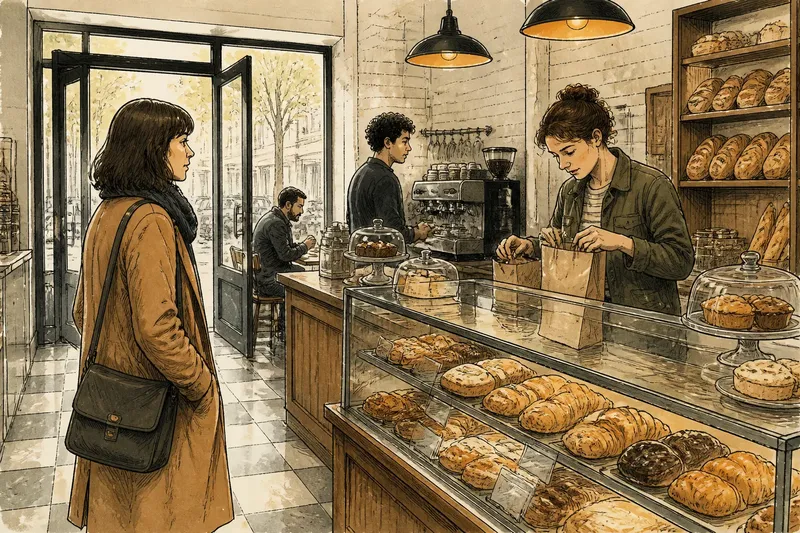
Imagine a fictional scene at a bakery counter. One stranger recognizes another, but the second is busy gathering a paper bag. A wide frame shows the first person waiting and the counter between them; after their eyes meet, a close-up could make the flicker of recognition easier to read. If the scene stays wide, viewers can instead watch both people adjust their posture at once. The choice trades a clearer look at one expression for a fuller view of their shared reaction.
The cut matters as much as the shot size. A close-up can redirect attention to a response; a return to the wider composition can show whether that response changes the distance, movement, or balance between the people.
What questions help read a first-meeting frame?
What does a wide shot show about who moves first?
Look for the first change in position: a step toward the other person, a turn, or a hand extended across a counter. If the frame keeps both people visible, you can compare that action with the other person’s response.
Does a close-up tell me exactly what someone feels?
No. It makes an expression more visible, but the expression still needs context. Check what prompted it and whether the other person’s action supports or complicates your reading.
Why keep both people in the same frame?
A shared frame lets viewers see how the characters respond to each other in real time. It can make a pause, a change in posture, or a new distance part of the same visual event.
When does a cut to a close-up feel motivated?
It feels connected when a specific reaction or gesture becomes newly important. If the wider view contains an action that leads into the close-up, viewers can link the expression to what just happened.
Which details are worth checking before interpreting the shot?
Keep observation separate from inference. “He looks toward the entrance” describes something visible; “he wants to leave” is a conclusion that may need more evidence. These checks can help you decide what the framing contributes:
- Check what the frame includes. If hands and posture are visible, use them to read the greeting; if only a face appears, hold off on conclusions about movement and look for a wider view.
- Check whether both people share the frame. If they do, compare their orientation and distance; if they do not, use the surrounding cuts to see how their reactions connect.
- Check what the setting physically changes. If a counter or crowd interrupts the approach, account for that before reading the pause as reluctance; if nothing blocks movement, consider other visible causes.
- Check what happens immediately before a close-up. If a gesture or look leads into it, connect the expression to that action; if no clear action does, treat the shot as a shift in attention rather than proof of a feeling.
- Check what returns after the close-up. If a wider view shows changed spacing or movement, note that consequence; if the scene stays close, avoid assuming the room has changed.
- Check what remains outside the frame. If another person or an exit appears later, revise your reading to include that new context; if the scene provides no such information, keep the interpretation tentative.
It is not worth treating every change in shot size as a hidden code. Sometimes a closer view simply makes a reaction easier to follow. Look for a concrete shift in attention or action before assigning a larger meaning.
Do first-meeting scenes need both shot sizes?
No. A scene can stay wide if the encounter works through movement and shared space, or remain close if viewers are meant to follow one person’s experience. A carefully arranged two-shot may carry both faces and the gap between them. The useful question is whether the chosen frame makes the moment’s important action clear.
For a wide shot or close-up in a first meeting, notice how the scene connects action to response. A wider view can establish who is present and what happens between them; a close-up can draw attention to one small reaction. The framing earns its place when it changes what viewers can follow, not simply because the camera has moved closer.