The Scene That Changes When a Character Stops Speaking
Learn how a pause in a film scene shifts attention through performance, sound, and editing, so you can follow a character’s changing choices.
The common mistake in reading a pause in a film scene is to treat it as empty space between lines. That misses the moment when a character’s silence changes who controls the exchange. Watch what happens to the relationship, not just the face: a pause can turn a demand into a decision, or a refusal into an opening.
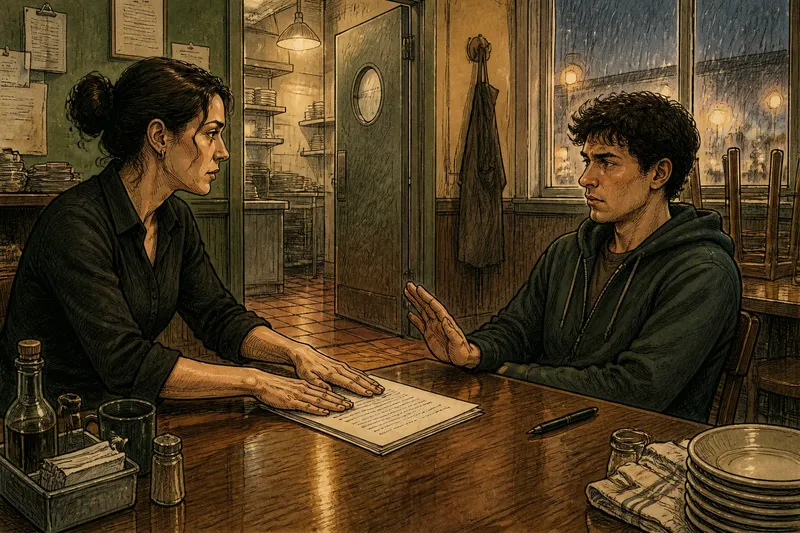
Consider an invented situation. Mara, a restaurant manager, asks her younger brother Eli to sign a statement taking blame for a broken display case. He says, “You know I can’t do that,” then falls silent. The scene’s tension now rests on a practical question: will Mara keep pressing, or will she change course?
What changes when dialogue stops?
Words make the request and refusal explicit. Silence shifts attention to the negotiation underneath them. Eli keeps his eyes on Mara but moves his hand away from the pen. His refusal has already been spoken; the movement makes it harder to dismiss as a passing objection.
That does not make the gesture a universal sign of resolve. Its meaning comes from the specific choice it changes: Eli is no longer poised to sign. Ask what each character can do now that they could not—or would not—do a moment ago. This keeps interpretation tied to the scene’s changing options rather than a catalogue of body-language clues.
How do the image and performance change the exchange?
If the film holds on Eli, his stillness becomes the focus. A cut to Mara makes her response the next event. A wider shot might keep both siblings and the statement visible, so the paper sits between them as a shared problem. Each framing makes a different part of the negotiation available to notice.
Performance gives those images their pressure. A tightened jaw or fingers withdrawing from the table can register a choice without announcing a single emotion. A larger gesture might make the refusal unmistakable, or show that Eli is losing control of his composure. Instead of asking whether the acting is subtle, ask what changed in the characters’ options after the gesture.
Imagine Mara smooths the statement instead of answering. If she does it after Eli moves away from the pen, the action may look like an attempt to restore order or regain control of the conversation. If she had done it before his refusal, it might read as routine handling of paperwork. The placement of the gesture in the exchange gives it meaning; no fixed dictionary can settle it.
How does a reaction alter what a line means?
Mara’s “I thought you’d understand” can sound pleading, accusatory, or exhausted, depending on her delivery and what Eli does with it. His response may change the force of her words even if he says nothing. A scene’s meaning often comes from the gap between what one person intends and what the other allows.
Timing matters. If Mara reacts while Eli is speaking, she may seem to anticipate or reject his point. If she waits until he finishes, the same look can feel considered—or calculated. A delayed glance tells us she has heard him, but not necessarily what she will do.
In the invented restaurant scene, suppose Mara looks toward the door only after Eli withdraws his hand. That sequence makes the exit newly relevant: she might be considering that he could leave, or searching for someone else to support her. The film can leave both possibilities open. What matters is that the glance follows a change in their leverage.
What does the room contribute to a pause?
Silence does not always mean a soundless room. A refrigerator hum, rain at a window, a chair creak, or paper sliding across a table can remain audible after dialogue stops. Those sounds keep the scene grounded in its setting and may bring a character’s movement forward.
Music can sustain pressure beneath a pause, while a sudden break in the score can expose ordinary room sounds. Neither choice supplies a universal emotional instruction. Listen for how the sound changes what the characters can hear or what the viewer attends to.
In the invented scene, imagine the paper rasping as Mara slides it away from Eli. That small noise gives the movement a definite endpoint. Without it, attention might stay on their faces. The sound does not explain the siblings’ feelings; it marks a change in the physical negotiation over the statement.
Why does the next action matter more than the pause alone?
A pause gets its shape from what ends it. If Eli answers quickly after Mara smooths the paper, the exchange still feels open. If he waits until she reaches for the pen, then her action becomes the new question: will she sign, insist, or let the statement go?
Editing shapes that interval. A cut can bring one face forward or shift attention to the paper before either character moves. A held shot keeps people and objects together in the same stretch of time. Either choice can make the negotiation feel shared or divided; the useful question is what the edit lets us compare.
Say Mara draws the statement toward herself and begins folding it. Eli reaches out—not for the pen, but to stop the fold. The invented scene has now shifted from whether he will sign to whether they can keep talking. The sequence of choices creates that turn: refusal, withdrawal, Mara’s move, then Eli’s late interruption.
What should you look for in a silent pause?
Does a pause always mean hesitation?
No. A character may be holding a boundary, waiting, listening, or choosing not to answer. Compare the silence with the next action to see which reading the scene supports.
How can you tell whether a gesture changes the scene?
Check whether it changes a character’s position, relationship to an object, or available next move. If nothing in the exchange shifts, the gesture may be incidental rather than a turning point.
What does a cut during a pause contribute?
A cut redirects attention to a face, object, or space. Ask what the new shot lets you compare with the previous one and what it removes from view.
Should every silence have a hidden meaning?
No. A pause may simply give a performance room to breathe or allow a practical action to happen. If the scene leaves the motive uncertain, keep that uncertainty rather than forcing an answer.
What is not worth the effort?
It is not useful to assign a fixed meaning to every glance, breath, or hand movement, then treat that reading as the only correct one. You also do not need to time a pause with a stopwatch. Those habits turn attentive viewing into clue-hunting and can obscure the relationship that is changing.
Instead, follow the scene’s negotiation: who makes the last explicit demand, who changes the available choices, and what response follows? In the invented example, Eli’s silence does not tell us whether he trusts Mara or what he will do about the statement. It does show his hand leaving the pen, Mara deciding what to do with the paper, and Eli choosing whether to reopen the exchange. That sequence is the useful center of a pause in a film scene.