A One-Scene Rewatch for a Quiet Evening
A one-scene rewatch makes editing easier to follow: see how entrances, exits, and changes in screen time shape the scene’s pace and story.
The common mistake in a one-scene rewatch is pausing at every cut. It breaks the scene’s rhythm and makes it harder to tell how editing shapes the action. Instead, watch once without interruption, then return with one clear question: how does the sequence of shots change what happens next?
This exercise is for noticing construction, not decoding a hidden message. Choose a scene with a beginning, a shift, and an ending. On the second pass, follow how one moment leads to another: a character’s arrival may interrupt an exchange, or a cut to a waiting face may hold the story at a turning point.
How do you choose a scene for a one-scene rewatch?
Pick a stretch that feels complete on its own. A conversation that begins with a request and ends with an answer works well. So does a character searching a room and leaving with new information. You do not need the scene to make full sense without context, but you should be able to follow its basic action.
A kitchen, office, hallway, train compartment, or waiting room can make movement easy to track. Notice where people enter and leave, and what they do between those moments. Avoid a sequence that depends on a complicated chain of action if you are still getting used to watching for edits.
Choose a familiar scene or one that caught your attention during a first viewing. Familiarity can help you notice the order of shots; a fresh scene can make that order less predictable. Either way, do not expect every cut to carry a hidden clue.
What should you do on the first pass?
Watch from the scene’s opening to its end without pausing or rewinding. Follow the story as you normally would. At the end, note one plain impression: perhaps the exchange felt tense, or one character seemed to take control.
Keep that impression open to revision. “The visitor seems to change the conversation” is something you can check on the next pass. “The film proves that nobody can be trusted” makes a broad claim that one scene may not support.
If your player has chapter markers or scene selection, use them to return to the same stretch. If not, start a little before the scene rather than scrubbing through its middle. A consistent start makes it easier to compare the two viewings.
How does editing shape a scene’s sequence?
On the second pass, follow the order of information. When does the scene show a new person? Does it first show a reaction, then the cause, or the other way around? Does it cut from a speaker to a listener before the reply arrives? These choices can alter suspense, emphasis, or the pace of an exchange.
Track one character at a time. Notice whether the scene shows them enter, begins with them already in the room, or introduces them through a voice from offscreen. Then follow what happens after they leave. The edit may stay with the people who remain, or cut to the departing character and carry the scene elsewhere.
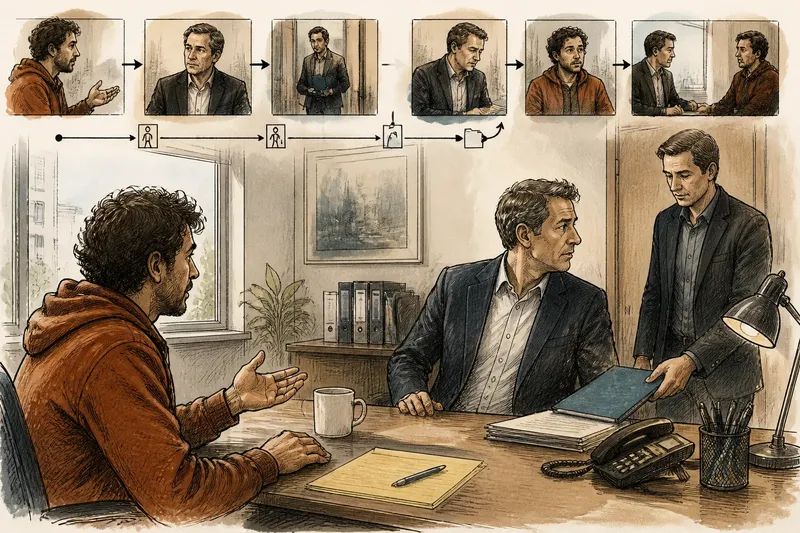
Say you choose a scene with a tenant explaining a repair problem to a building manager. A colleague enters and sets a folder on the desk. The manager turns toward the folder, and the tenant stops speaking. Later, the colleague leaves, and the tenant resumes the explanation. On a second pass, you can trace the sequence: the edit introduces the interruption, stays with the manager’s response, then returns to the tenant. That order makes the interruption part of the scene’s action without proving a single intended meaning.
If the room becomes hard to follow, reduce the task. Keep track of who is present and what changes after each cut. You do not need to memorize every camera angle or count every edit.
What should you ask on a closer pass?
Does the scene show every entrance?
No. A character may be heard before appearing, or the edit may reveal them only after they have entered. Notice what the scene shows first and how that order changes the information available to you.
Why cut to a listener after a line ends?
The listener’s response may affect how the line lands, or the cut may keep the conversation’s rhythm moving. Describe what the edit gives you before deciding what the reaction means.
Should you count every cut?
Usually not. Counting can distract from the sequence of events, so focus on the edits that change what you know or what happens next.
What if the room is difficult to follow?
Return to the basics: who is present, where they are, and what changes between shots. If the scene still feels confusing, choose a simpler exchange for another viewing rather than forcing yourself to track every detail.
How can you turn an observation into a useful note?
After the second pass, compare your first impression with the order of events you noticed. If the visitor seemed to take over the conversation, ask whether the edits support that impression. Perhaps the scene follows the manager’s response instead, leaving the tenant’s interruption unresolved.
One note and one question are enough. For the invented tenant-and-manager scene, you might write: “The manager turns to the folder before the tenant finishes. Does that make the interruption feel decisive, or simply brief?” This records what happens and leaves room to reconsider the interpretation.
- Check whether the scene begins with everyone already present; if so, track the first change in who speaks or acts, then use that moment as your starting point.
- Check whether a new character appears before anyone reacts; if so, note the entrance and follow whose action comes next, but if the reaction arrives first, watch for what the edit reveals afterward.
- Check whether a cut changes the speaker or the listener; if it changes to the listener, note the response before the next line, but if it stays with the speaker, follow how the dialogue continues.
- Check whether the scene returns to a character who had been left offscreen; if so, note what has changed while they were absent, but if nothing changes, keep your attention on the ongoing exchange.
- Check whether the scene ends on an action or a reaction; if it ends on a reaction, note what remains unresolved, but if it ends on an action, follow how that action closes the scene.
- Check whether you can describe the order of events in plain language; if you can, compare it with your first impression, but if you cannot, replay only the confusing stretch or choose a clearer scene.
A third pass is useful only when you have a specific uncertainty, such as whether the scene shows the colleague before the manager turns. Replaying the whole movie to check one small detail is not worth the effort. The scene may remain open to more than one reading.
For a one-scene rewatch, the useful result is a clearer account of how the scene is assembled: what arrives first, what changes after a cut, and what the ending leaves in motion. That gives you a concrete way to talk about editing without requiring the scene to explain itself completely.