The Red Object Is Not Automatically a Warning
A recurring red object in a film can mean more than danger. Learn to track its changing role, relationships, and visual emphasis without flattening the image.
The common mistake with a recurring red object in a film is to decide at its first appearance that red means danger. That shortcut can make later scenes feel predictable and leave you blind to changes in the image. A red object becomes interesting through its changing role in the frame, not through a color code alone.
Follow what the object does as the film moves on. Is it handled, abandoned, hidden, or brought close to someone? Those actions can connect scenes in ways a fixed symbol cannot.
What does the object do when it first appears?
Begin with what the shot plainly shows. Is the object a coat, a cup, a traffic light, or a mark on a wall? Does it serve an ordinary purpose in the scene, or does the camera give it unusual prominence? A red scarf worn for warmth enters the story differently from a warning lamp built into a machine.
Notice its place in the frame. It might sit beside a character, occupy an empty corner, or stand out against muted colors. Focus, framing, and camera movement can direct your eye toward it. If it remains one detail among many, the film may not be asking you to treat it as a clue.
Record a plain description rather than a verdict: “a red umbrella rests beside the door.” That leaves room for a later scene to change what you think about it.
How can an object’s actions connect scenes?
Look beyond where the object sits. Who touches it? Who avoids it? Does someone pass it to another person, put it away, or leave it behind? A change in handling can link the object to a relationship or a decision more clearly than its color does.
Imagine a film that first shows a red thermos on a kitchen counter while a family talks around it. Later, it sits alone on a bus seat after one character has left. The changed location and absence of its owner make the thermos seem left behind; they do not establish that the character is in danger. The object connects the scenes through what has happened to it.
That kind of connection is especially useful when the film repeats an action. A character may keep offering the same object, or another may refuse it each time. The repeated gesture can matter even if the object’s color never receives special emphasis.
When does the camera make the object matter?
Compare how the film presents the object on each appearance. Is it centered or pushed to the edge? Does the camera hold on it, shift focus toward it, or let it pass in the background? A tight shot can make a familiar item feel newly significant; a wide shot may show that it belongs to a larger arrangement.
Sound and editing can shape that attention, too. A cut from a character’s face to an object can connect the two in the viewer’s mind. A pause before the next shot may give the object room to register. These choices do not prove a single interpretation, but they show how the film guides attention.
It is not worth the effort to count every red detail or freeze the film over background objects. Follow the items the camera returns to, isolates, or places in a meaningful action.
How should you track a recurring red object?
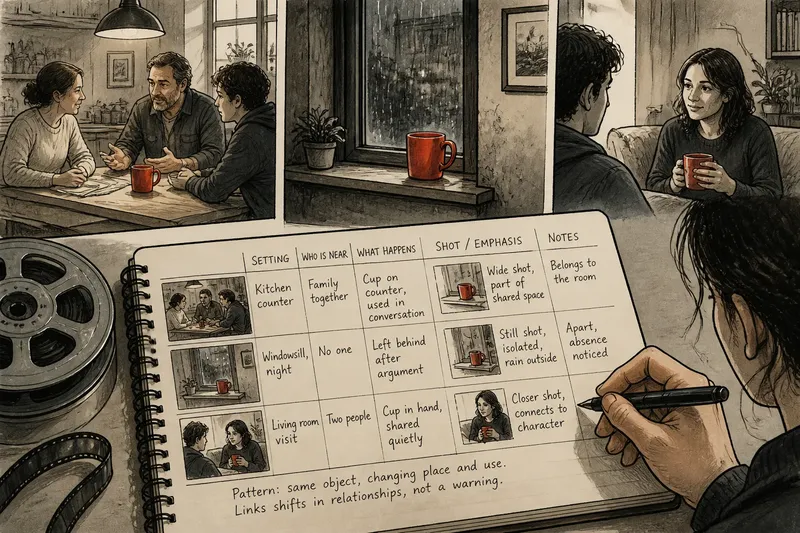
A few concrete notes can reveal a pattern without turning the film into a code puzzle. For each appearance, jot down the setting, who is near the object, what happens to it, and how the shot directs your attention. Then compare the notes for changes.
- If the object is handled by the same character each time, note the repeated gesture; if another person takes it, consider how that changes the relationship.
- If the object stays in the same place while the scene changes, treat its setting as a point of continuity; if it moves, note who moved it and where it goes.
- If the camera isolates the object with a close view or a focus shift, consider it emphasized; if it remains in a wide, busy frame, treat it as less prominent unless later scenes return to it.
- If the object appears near the same person across scenes, compare what that person is doing; if the person changes, look for a new connection rather than assuming the old one persists.
- If a character uses the object for a clear practical purpose, account for that action first; if it is left unused, ask what the surrounding scene makes noticeable about its presence.
- If later appearances repeat the original framing, consider a deliberate visual echo; if the framing changes, examine whether the new composition alters the object’s relation to people or space.
Say you are watching an invented film in which a red cup appears on a kitchen counter during a family conversation, on a windowsill after an argument, and later in a character’s hand during a quiet visit. Your notes record the setting, who is present, and whether the cup is used. At the counter, it belongs to the shared room; on the windowsill, it sits apart after the argument; in the character’s hand, it becomes part of a new interaction. The resulting interpretation is modest but grounded: the cup links changing relationships to a familiar household object. It does not need to symbolize danger.
What questions help you read a recurring red object?
Does red always mean danger in a movie?
No. Color can contribute to a mood, but it does not settle an object’s meaning by itself. Read the object alongside its use, setting, and relationship to the characters.
How can I tell if the object is meant to stand out?
Notice framing, focus, contrast, and whether the film returns to it. A red item in a busy market may draw less attention than a small red detail isolated in a quiet frame.
Should I look up a film’s symbolism before watching?
You can form an initial reading from the images, then compare it with other interpretations afterward. That gives you a chance to notice what the film presents before adopting someone else’s explanation.
What if the object appears only once?
A single appearance can contribute to a shot without carrying a hidden message. Ask what it adds to the immediate scene, and avoid claiming a larger pattern without further visual support.
When red catches your eye, follow the object through its actions, framing, and changing company before settling on an interpretation. For a recurring red object in a film, that approach keeps your reading specific: you can describe what changed, then decide how much meaning the images support.